In brief
Forest School is a programme of regular sessions in woodland or other natural ground, led by a trained practitioner. It is not a one-off trip or a single outdoor lesson. The Forest School Association, a UK charity, is the professional body that sets out what counts as Forest School.
On this page
You have probably heard a colleague say “we do Forest School on Fridays” and meant anything from a nature walk to a full morning in the woods. The term gets used loosely, but in the UK it has a fairly specific meaning, and knowing it helps when you plan the space and the timetable.
This post explains what Forest School is, how it differs from an ordinary outdoor lesson, and what a school needs on the ground to run it well.
Forest School in plain terms
Forest School is a way of learning outdoors through regular sessions, usually over a long stretch of time, in woodland or another natural setting. It is led by a trained practitioner rather than whoever happens to be free that afternoon.
The Forest School Association is a registered charity and the professional body for Forest School in the UK. It publishes the principles that set Forest School apart, and it is the best place to read them in full. In other words, if you want to know whether what your school does “counts”, that is the reference.
What it isn’t is a single trip. A day at an outdoor centre can be brilliant, but it is a different thing.
How it differs from an outdoor lesson
People often mix up three things: Forest School, a lesson taught outside, and using an outdoor classroom. They overlap, but the differences matter when you plan staff and space.
| Forest School | Outdoor lesson | Lesson in an outdoor classroom | |
|---|---|---|---|
| Who leads it | A trained Forest School practitioner | The class teacher | The class teacher |
| Where | Woodland or natural ground | Anywhere in the grounds | A shelter or building in the grounds |
| How often | Regular sessions over a long period | Whenever it suits the topic | Timetabled like any room |
| What drives it | The children’s interests and play | The lesson plan | The lesson plan |
The last row is the big one. A maths lesson outside still has a learning objective set by the teacher. Forest School leans much more on children choosing, trying and taking managed risks, with the adult supporting rather than directing.
What a school needs on the ground
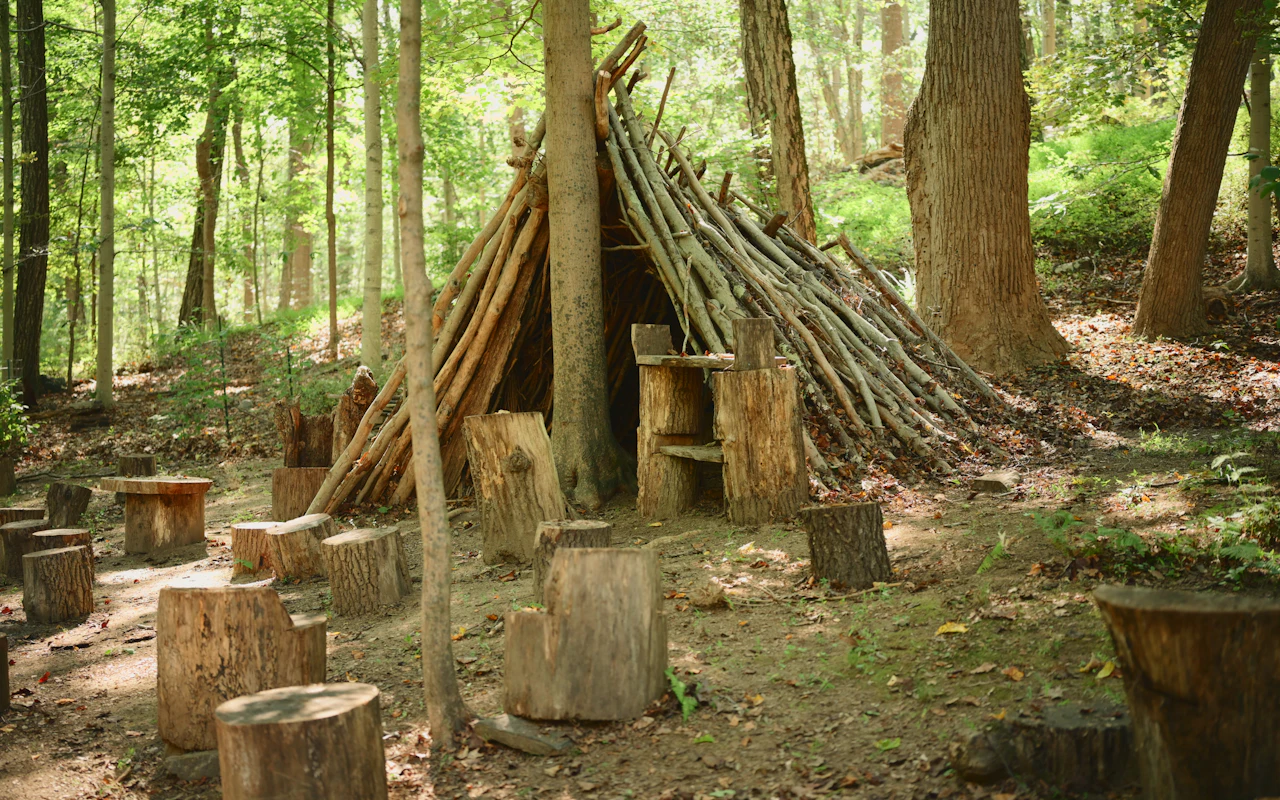
You don’t need acres of ancient woodland. Plenty of schools run Forest School on a wild corner of the field with a few trees, a hedge and some long grass. What matters is that the space feels natural and that it is there every week.
A few things make sessions far easier to run.
- A base camp. Somewhere the group gathers at the start and end, usually with seating in a circle.
- Cover. A tarp works, but a permanent roof saves setting up every week and gives a dry spot when the weather turns.
- Storage. Tools, tarps, ropes and spare waterproofs live best in a lockable store near the site.
- A route. A path that doesn’t turn to mud by November, so groups can get there quickly.
Most schools start with tarps and add a permanent forest school shelter once sessions are well established.
A worked example: planning a base for one class
Say a primary school wants to run weekly Forest School for one Year 3 class in a wooded corner of its own field. The leader wants everyone able to sit under cover together, a log circle, and somewhere to keep tools.
The school’s options look like this. A tarp strung between trees costs very little but takes time each week and blows about in wind. An open timber shelter over a log circle gives a fixed, dry base. A small store beside it keeps the kit on site.
Because the woodland is on the school site in England, a permanent shelter is a new school building, so it is checked against Class M permitted development: up to 5 m high within 10 m of the site boundary, 6 m elsewhere, and nowhere within 5 m of a boundary with homes. If that wooded corner backs onto gardens, the shelter has to sit at least 5 m in from the fence.
Common worries, answered
“Isn’t it risky?” Managed risk is part of the point, but it is managed. A trained leader carries out risk assessments and builds skills up gradually.
“What about the weather?” Sessions usually go ahead in most weather, which is exactly why cover and good kit matter so much.
“Will it eat into curriculum time?” Many schools find it supports speaking, listening and science, and some link it to their outdoor learning plan across the school.
Where to go next
If your school is thinking about Forest School, start with the Forest School Association’s guidance and a conversation with a trained practitioner. Then think about the space. A dry base camp is the one piece of kit that changes how often sessions actually happen.
Our guide to outdoor classrooms covers the wider range of shelters and buildings schools use.
Thinking about a permanent base in your school’s woodland? The form below is the place to start a quote.